Device Connectivity
Communication layers suited to constrained devices and unreliable networks.
“What happens when the device loses connectivity?”
It should keep working. Local autonomy with buffered telemetry and reconciliation on reconnect is the baseline. Products that depend on a live connection fail in exactly the conditions they'll actually meet.
Communication layers suited to constrained devices and unreliable…
Ingestion and storage designed for continuous device data…
Device registry, grouping, health monitoring, and staged over-the-air firmware updates with rollback — because a bad update…
Mobile and web apps for setup, control, and monitoring — designed to handle offline devices and stale state gracefully rather…
Connected hardware carries constraints software teams rarely face. Devices lose connectivity, run on constrained power budgets, ship firmware that's hard to…
Communication layers suited to constrained devices and unreliable networks.
Ingestion and storage designed for continuous device data volumes.
Device registry, grouping, health monitoring, and staged over-the-air firmware updates with rollback — because a bad update pushed to a whole fleet is close to unrecoverable.
Mobile and web apps for setup, control, and monitoring — designed to handle offline devices and stale state gracefully rather than showing spinners forever.
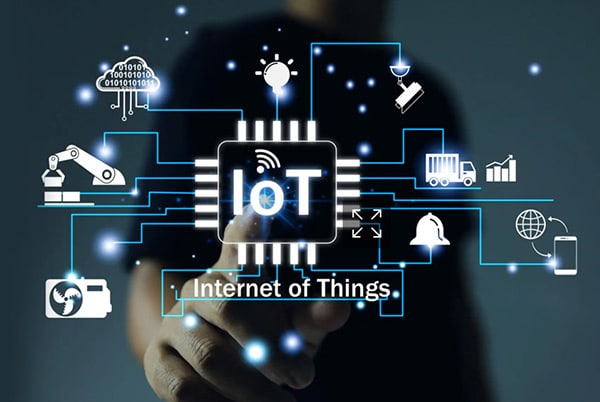
The Internet of Things (IoT) connects physical devices and sensors to software systems and networks so they can collect, exchange, analyze, and act on data — sensors, machines, vehicles, appliances, wearables, industrial equipment, smart buildings, energy systems, agricultural equipment, medical devices, and consumer products.
Our IoT development services combine connected devices, cloud platforms, APIs, databases, analytics, mobile applications, automation, and AI to create complete IoT ecosystems.
Every IoT product has different devices, sensors, workflows, data requirements, and business goals. We build custom IoT software solutions designed around your specific use case.
Constrained devices and unreliable networks shape every technology choice in IoT.
The layer that knows every device you have deployed, what state it is in, and whether it can be trusted.
IoT platforms handling device registration, device authentication, device management and sensor management, with real-time data, device monitoring, remote control, alerts, notifications, data storage, analytics, dashboards, user management, API integrations and automation.
Device configuration, device status, device grouping and device lifecycle management, with firmware management and remote updates so a fleet in the field can be patched without a site visit. Device alerts flag units drifting out of spec.
IoT application development and IoT mobile apps letting users monitor devices, view sensor data and sensor readings, control connected equipment, receive alerts, configure devices, track assets, view historical information and manage multiple devices from one account.
Device dashboards with real-time monitoring, remote device control, historical data, reports, user accounts, location tracking and analytics — connected device software that stays legible as the fleet grows.
Where the sensors are physically deployed changes everything — the tolerances, the connectivity and the cost of being wrong.
Machine monitoring, equipment monitoring and production tracking with asset monitoring, predictive maintenance and energy monitoring, plus operational analytics, automated alerts, remote monitoring and performance analytics across the plant.
Building monitoring and occupancy monitoring with energy management, smart lighting, HVAC monitoring, access control, environmental monitoring, equipment monitoring, security systems and automated alerts.
Smart lighting, smart security, smart locks and smart thermostats, with energy monitoring, appliance control, environmental sensors, remote device control and home automation that degrades gracefully when connectivity drops.
Remote monitoring systems reporting real-time device status, sensor readings, location and performance data, with alerts, historical data, maintenance notifications and remote controls. IoT asset tracking adds real-time location, asset status, movement history, geofencing, asset utilization and analytics.
Connect manufacturing equipment and operational data through smart manufacturing and IoT technology. Real-time dashboards give teams better visibility into manufacturing operations.
A smart manufacturing platform can help businesses monitor production equipment, machine performance, production output, downtime, energy consumption, maintenance requirements, and operational efficiency.
IoT
Firmware, gateways, telemetry pipelines and control interfaces built as one connected system.
Sensor data is only worth collecting if someone can act on it. This is the part that turns readings into decisions.
Real-time metrics, sensor readings and device status alongside performance indicators, historical trends, alerts, location data, energy consumption, production data and maintenance information, with geolocation and data visualization built in.
Real-time analytics and historical analysis with performance monitoring, trend analysis, anomaly detection, operational analytics, predictive analytics and custom reports.
Predictive maintenance and anomaly detection producing intelligent alerts, with equipment performance analysis, demand forecasting, pattern recognition, automated decision-making and intelligent automation — flagging the failure before it becomes downtime.
Prevent unexpected equipment problems with IoT predictive maintenance solutions. Connected sensors collect information about equipment conditions and performance, and analytics and machine learning help identify unusual patterns that may indicate potential maintenance requirements.
Predictive maintenance can support: equipment monitoring, condition monitoring, failure prediction, maintenance alerts, asset performance, maintenance scheduling, and downtime reduction.
Automate actions based on device data, sensor readings, events, or predefined conditions.
Automation can support smart buildings, manufacturing, agriculture, energy management, logistics, security, equipment monitoring, and connected products.
Connected devices widen the attack surface and the data volume at the same time. Both have to be designed for, not retrofitted.
Device connectivity with data ingestion, data storage and real-time processing, plus analytics, device management, APIs, dashboards, notifications and automation on cloud infrastructure sized for continuous telemetry.
IoT API integration with CRM systems, ERP systems, cloud platforms and analytics systems, through to mobile applications, web applications, payment systems, business dashboards, AI services and third-party APIs.
Device authentication and user authentication with access control, secure APIs, data protection, encryption, permissions, monitoring and secure device communication as a design constraint rather than a hardening pass.
IoT MVP development with selected device integration, sensor data collection, a basic IoT platform, device management, dashboard, alerts, a mobile or web application, basic analytics and API integration — on scalable architecture with API-driven development, database optimization, real-time data processing and performance optimization.
Whatever industry you're in, our IoT solutions are built around how you actually work.
Monitor machines, production systems, equipment, energy consumption, and operational performance.
Track vehicles, shipments, assets, routes, and operational conditions.
Use connected sensors and devices for monitoring environmental and agricultural conditions.
Develop connected applications for appropriate devices, monitoring systems, healthcare workflows, and data management.
Create smart building platforms for energy, security, occupancy, equipment, and facility management.
Connect smart devices, inventory systems, customer experiences, and store operations.
Monitor energy consumption, connected equipment, and operational performance.
Develop connected vehicle applications, fleet monitoring, asset tracking, and vehicle data platforms.
Build connected systems for infrastructure, transportation, energy, environmental monitoring, and public services.
We combine software engineering, mobile development, web development, cloud technology, APIs, data analytics, AI, automation, and IoT architecture to create connected technology solutions.
We build around your devices, workflows, users, and business requirements.
We design IoT systems that can grow with your device network and data volume.
We create dashboards and applications that provide visibility into connected systems.
We integrate AI and automation to move your IoT system from monitoring toward intelligent operations.
We consider device authentication, access control, APIs, data protection, and secure communication.
Different teams describe this work differently — here's how it maps to what we actually build.
11Seas works as an IoT software development company and IoT development company, delivering Internet of Things solutions and IoT technology solutions to businesses across industries. As an IoT solutions company and IoT technology company, we cover IoT consulting services, IoT product development, and IoT system development end to end — from IoT application development company and IoT platform development company-level delivery to IoT integration services and IoT application development services for teams that need the connectivity layer handled alongside the software.
On the industrial side, that's IIoT solutions and Industrial IoT software for connected manufacturing — sometimes factory IoT solutions, sometimes broader IoT manufacturing solutions depending on the plant. We build industrial IoT monitoring, predictive maintenance IoT, and industrial sensor monitoring as one connected layer rather than separate systems.
For connected spaces, that's smart home solutions and IoT smart home work on the residential side, or smart building IoT and IoT building management for commercial properties. We build connected home technology, home automation software, and IoT home automation for individual units, alongside smart office solutions, smart facility management, and a full connected building platform for larger portfolios.
On the device side, that's IoT device development and IoT gateway development connecting hardware to the cloud, backed by IoT device integration and IoT sensor integration for existing equipment. We ship the interface as an IoT web application, IoT dashboard development, IoT monitoring software, an IoT control panel, or IoT remote monitoring depending on how your team needs to interact with the fleet. Behind the scenes, cloud IoT solutions and IoT cloud integration handle the infrastructure, while an IoT analytics platform and IoT data management turn raw readings into real-time IoT analytics and IoT data visualization your team can act on. On the intelligence side, AI IoT solutions and an AI IoT platform apply machine learning IoT and predictive analytics IoT to device data, powering smart IoT automation and what's broadly described as IoT artificial intelligence across the connected system.
“Build your IoT solution”
Whether you need IoT software development, an IoT platform, connected device software, Industrial IoT solutions, smart home technology, smart building systems, IoT dashboards, asset tracking, predictive maintenance, or AI-powered IoT applications, our software development team can help bring your idea to life. We build technology that helps businesses connect devices, collect data, monitor operations, automate processes, and make smarter decisions — from IoT MVP development to large-scale connected ecosystems. Have an IoT idea? Let's build your connected future.
AWS IoT Core, Azure IoT Hub, and Google Cloud IoT, as well as custom MQTT infrastructure when managed platforms don't fit the cost or control requirements.
We focus on the connectivity layer, cloud platform, and applications, and collaborate closely with firmware teams. For embedded work we partner with specialists.
Certificate-based provisioning with a manufacturing-time identity injection process, plus a user-facing onboarding flow simple enough for non-technical customers.
Edge aggregation reduces what gets transmitted, and time-series databases with tiered retention handle what arrives. Raw high-frequency data rarely needs indefinite retention.
Per-device certificates, mutual TLS, signed firmware, least-privilege cloud permissions, and network segmentation. We assume physical device access is possible.
Yes, provided the device exposes a usable interface. We start by assessing existing protocols and constraints before proposing an architecture.
IoT software development covers the full stack around connected hardware, including device connectivity, telemetry pipelines, fleet management dashboards, and companion mobile apps, plus embedded firmware when needed.
Yes. Embedded systems firmware engineering is part of our IoT capability, so hardware-level and software-level development stay coordinated rather than handled by separate vendors.
Telemetry pipelines are designed for the data volume and frequency your fleet actually produces, with fleet management tooling built to monitor and manage devices as the deployment grows.
IoT software development involves creating applications, platforms, dashboards, APIs, and cloud systems that connect and manage physical devices, sensors, machines, and other connected technologies.
We develop IoT platforms, connected-device applications, IoT dashboards, device management systems, Industrial IoT solutions, smart building platforms, asset tracking systems, predictive maintenance solutions, and AI-powered IoT applications.
Yes. A custom IoT platform can include device management, sensor integration, real-time monitoring, dashboards, alerts, analytics, automation, APIs, and cloud infrastructure.
Yes. We can develop mobile applications that allow users to monitor and control connected devices, view sensor data, receive alerts, and manage IoT systems.
Industrial IoT, or IIoT, applies connected devices, sensors, software, analytics, and automation to industrial environments such as manufacturing, logistics, energy, and industrial operations.
Yes. AI can be used with IoT data for predictive maintenance, anomaly detection, intelligent alerts, forecasting, pattern recognition, and automation.
Yes. We can develop smart home applications and platforms for connected lighting, security, energy monitoring, appliances, access control, and home automation.
Yes. IoT platforms can connect with existing business applications through APIs and integrations, including CRM, ERP, analytics, cloud, mobile, and web systems.
Yes. We can identify the core device, data, application, and platform requirements and develop an MVP before expanding the connected ecosystem.
Connected products can't assume reliable networks, cheap bandwidth, or easy updates. Designing around those constraints from the start is what separates IoT platforms that scale from ones that struggle in the…
Get clarity on your idea, scope, and next steps — in one short call.