
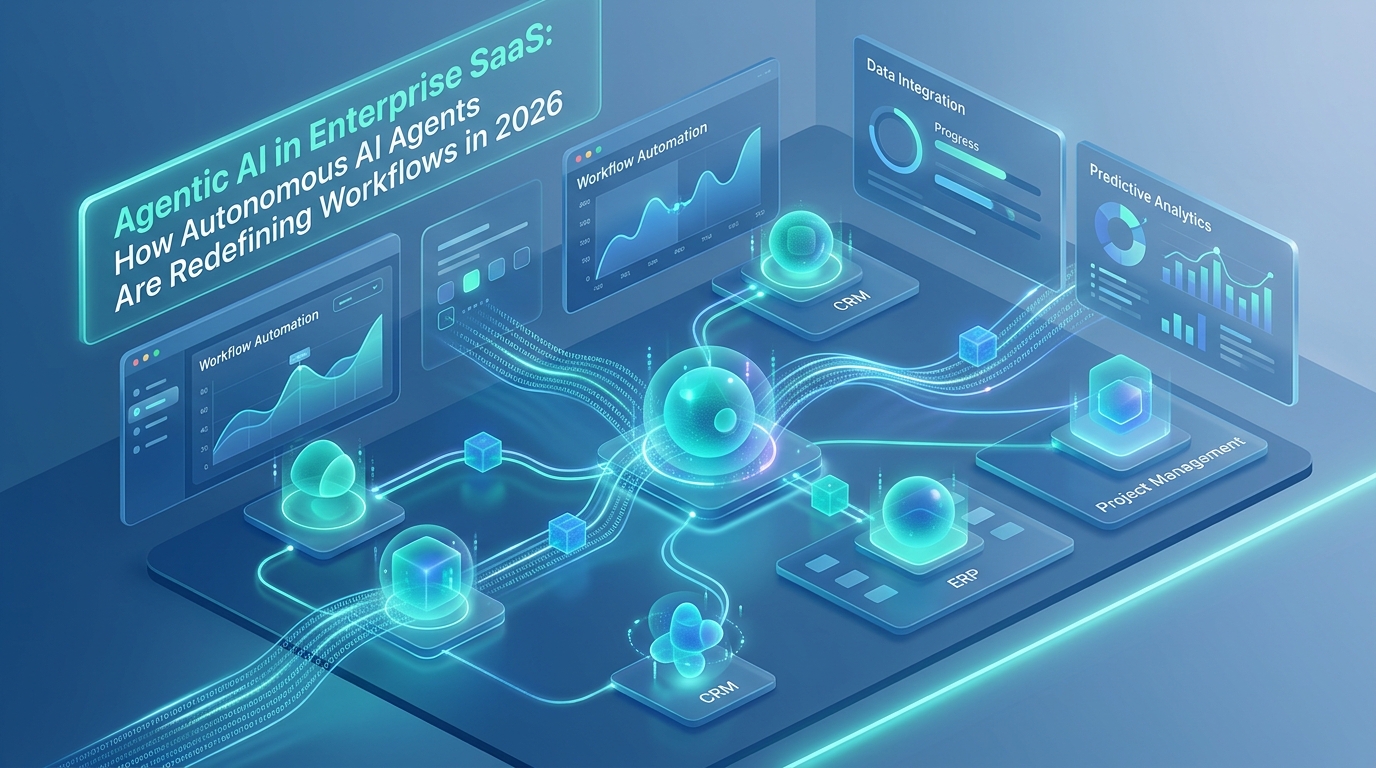
Artificial intelligence in modern software has crossed a major threshold. Over the past few years, businesses integrated Generative AI into their SaaS products—adding chat widgets, automated summarizers, and AI writing assistants. While useful, these solutions remained fundamentally reactive: a human had to prompt the model, review the output, and manually execute the next step in the workflow.In 2026, the paradigm has shifted to Agentic AI.Enterprise software is moving beyond simple text-generation interfaces toward autonomous AI agents—intelligent systems capable of reasoning, planning multi-step tasks, executing API calls, and making context-aware decisions with minimal human intervention.In this comprehensive guide, we examine what Agentic AI SaaS development entails, how multi-agent architectures function, key enterprise use cases, and how to safely deploy autonomous systems into production environments.What Is Agentic AI in SaaS?Agentic AI refers to software systems powered by Large Language Models (LLMs) or foundation models that possess agency. Rather than generating a single static response, an AI agent operates within a dynamic loop:$$\text{Perceive} \longrightarrow \text{Reason \& Plan} \longrightarrow \text{Select Tool} \longrightarrow \text{Execute Action} \longrightarrow \text{Evaluate Result}$$Generative AI vs. Agentic AI in SaaSFeatureGenerative AI SaaSAgentic AI SaaSPrimary FunctionContent creation & text summarizationAutonomous execution & task completionUser InteractionPrompt $\rightarrow$ Response (Single turn)Goal $\rightarrow$ Multi-step execution (Autonomous)Workflow RoleAssists the human operatorExecutes the workflow independentlyTool UsageIsolated model APIsIntegrated with external APIs, databases, and microservicesDecision MakingHuman makes decisions based on AI outputAgent evaluates outcomes and self-correctsFor example, when handling a complex billing inquiry:A Generative AI system drafts a polite email response for a human customer support representative to review and send.An Agentic AI system reads the ticket, queries the billing database via API, verifies the refund policy, processes the refund transaction, updates the CRM status, and notifies the customer automatically.Key Enterprise Use Cases for Agentic SaaSOrganizations across industries are deploying autonomous agentic workflows to convert high-effort, repetitive business processes into scalable software systems.1. Customer Operations & Revenue ManagementAutonomous Dispute Resolution: Agents inspect transaction logs across payment gateways, check account history, issue refunds within pre-approved limits, and update ERP systems.Lead Qualification & Nurturing: Agents research prospective accounts, enrich lead data via external tools, schedule multi-stakeholder calendar invites, and draft custom technical proposals.2. DevOps & Software EngineeringSelf-Healing Infrastructure: Monitoring agents detect anomaly spikes in cloud workloads, isolate failing microservices, initiate fallback routines, and submit pull requests with fix proposals to engineering teams.Automated QA & Regression Testing: Testing agents crawl new frontend builds, identify breaking visual or functional regressions, write end-to-end integration test scripts, and log ticket items in Jira.3. Supply Chain & OperationsDynamic Inventory Rebalancing: Operational agents track regional inventory levels, analyze predictive demand forecasts, and automatically trigger purchase orders or supplier transfers when stock drops below safety thresholds.Core Technical Architecture of an Agentic SystemBuilding production-grade Agentic SaaS requires more than making a basic API call to an LLM. It demands a robust, resilient system architecture built around four core pillars:+-----------------------------------------------------------------+
| Agent Brain |
| (Reasoning, Planning, & Strategy) |
+-----------------------------------------------------------------+
|
+-----------------------+-----------------------+
| |
+---------------+ +-----------------------+ +---------------+
| Short/Long | | Function Calling | | Human-in-the |
| Term Memory | | & Tool Execution | | -Loop (HITL) |
| (Vector DB) | | (APIs, DBs, Shells) | | Safeguards |
+---------------+ +-----------------------+ +---------------+
1. The Reasoning Engine (Planning)The core foundation model acts as the brain. The agent breaks down high-level user objectives into sub-tasks using techniques like Tree of Thoughts (ToT) or ReAct (Reason + Act) framework prompting, evaluating potential paths before choosing an execution strategy.2. Tool Integration & Function CallingAgents interact with the world through structured function calling. Through OpenAPI specifications, agents are provided with discrete, well-defined tools (e.g., fetch_user_balance(), send_slack_alert(), execute_sql_query()).3. State Memory ArchitectureShort-Term Memory: Maintains the immediate context and execution state during an active workflow run.Long-Term Memory: Uses Vector Databases (such as Pinecone or Milvus) paired with semantic embeddings to store historical preferences, domain-specific knowledge, and past execution logs.4. Multi-Agent OrchestrationFor complex workflows, a single agent can easily overload its context window or produce hallucinated loops. Modern architecture uses Multi-Agent Systems (MAS), where specialized agents collaborate:Planner Agent: Outlines the overall strategy and assigns sub-tasks.Execution Agents: Specialized agents dedicated strictly to coding, database queries, or writing.Critic/Evaluator Agent: Inspects outputs against defined criteria and requests self-correction before completion.Security, Governance, and Human-in-the-Loop (HITL)Granting software systems the authority to execute actions natively introduces technical and operational risks. Robust governance frameworks are mandatory for enterprise adoption.Essential Security MeasuresDeterministic Guardrails: Implement non-LLM safety layers (such as NeMo Guardrails or custom middleware) that sanitize input inputs and enforce business rule boundaries before tool execution occurs.Least-Privilege Tool Access: Assign scoped API tokens and restricted database permissions to agent execution environments. An agent should never hold broad administrative credentials.Sandboxed Code Execution: When agents write or run dynamic code, execution must take place inside isolated, ephemeral container environments (e.g., Docker or WebAssembly sandboxes).Human-in-the-Loop (HITL) Checkpoints: High-impact actions—such as processing payments over a specified dollar threshold, deleting database records, or sending external communications—must pause execution and require explicit human approval via UI notification.How to Get Started with Agentic AI SaaSTransitioning from traditional SaaS or basic LLM integration to full agentic workflows requires a deliberate, iterative engineering strategy:Target High-Friction Workflows: Start with workflows that have clear inputs, deterministic verification criteria, and significant human operational costs.Standardize API Interfaces: Clean, well-documented REST or gRPC APIs make it significantly easier for agentic reasoning engines to invoke tools accurately.Establish Rigorous Evaluation Metrics: Build evaluation pipelines to measure task success rate, execution speed, token usage costs, and tool selection accuracy.Partner with Experienced AI Engineers: Designing scalable state machines, tool registries, and safe execution environments requires specialized engineering expertise.Build Next-Generation AI SaaS with 11SEASAt 11SEAS, we help forward-thinking companies design, build, and deploy production-grade AI SaaS platforms. Whether you are building an AI-native product from scratch or upgrading an enterprise SaaS platform with autonomous agentic workflows, our engineering team brings deep expertise across generative AI, multi-agent architectures, security compliance, and cloud engineering.
